
GEAR
the machinery of the sound

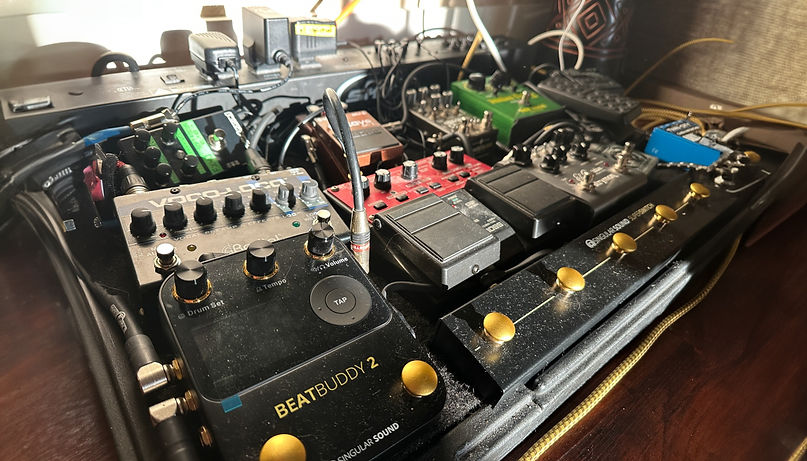
PEDALBOARD SPACESHIP It feels like I’m building a spaceship. Like I’m doing something Han Solo would get behind. It’s actually kind of exciting, but there’s also a little anxiety because it feels like there are a lot of technical parts. In BØTTØM I used to have two amplifiers and two pedal chains, but the pedals were pretty simple. I did a pedal dance for sure. But this is different. Now my feet and hands are in charge of everything. Rhythm. Bass. Loops. Guitar. They all lay the foundation and build the atmosphere for my vocals. I’m literally starting by writing with two-note progressions just to see how it goes—to stop the overwhelm before it happens. There’s anxiety and excitement at every step. And then there are the songs. At the core, there are always the songs. I’m trying to do them justice—to find a live rendition that belongs beside the recorded version, rather than simply trying to reproduce it. Strap in. Here we go. THE THREE BOARDS Three boards. Three jobs. One spaceship. One handles the physical guitar—the dirt, movement and decay that eventually hits a real tube amp. One builds the rhythm section: loops, octave and drums. The third takes guitar and voice somewhere less predictable. Together, they make the Mother King live rig. GIBSON SG "BONE" │ ▼ RADIAL TWIN-CITY ABY ╱ ╲ ╱ ╲ ▼ ▼ BOARD 1 BOARD 3 GUITAR DIGITAL / VOCAL │ │ ▼ ▼ MESA/BOOGIE PA / FOH STUDIO .22 BOARD 2 RHYTHM / LOOP │ ▼ PA / FOH 01 / GUITAR THE PHYSICAL SOUND This is the old-fashioned side of the spaceship: guitar, pedals, tubes, speaker. The SG hits the Radial Twin-City first, splitting the signal into two worlds. One stays here and travels through the analog board into the Mesa/Boogie. The other escapes to Board 3 and the HeadRush Core. Gibson '67 SG — "Bone" │ Radial Twin-City ABY │ ├──────────────────────────► Board 3 / HeadRush Core │ ▼ Boss TU-3W Waza Craft Tuner │ Dunlop Volume (X) Mini │ MXR Wylde Overdrive │ Way Huge Swollen Pickle │ Chase Bliss Gravitas │ Strymon El Capistan │ Mesa/Boogie Studio .22 THE MACHINERY Radial Twin-City ABY The fork in the road. An active ABY splitter sends the SG simultaneously toward the analog guitar rig and the digital HeadRush rig. Boss TU-3W Waza Craft Tuner. Unexciting until you don’t have one. Dunlop Volume (X) Mini Volume, swells and silence. Sometimes taking the guitar away is as important as adding another effect. MXR Wylde Overdrive The push. Straightforward overdrive before things get considerably less straightforward. Way Huge Swollen Pickle Fuzz. Big, ugly and capable of removing most remaining traces of good judgment. Chase Bliss Gravitas Analog tremolo. Movement, pulse and instability. Strymon El Capistan Tape echo. Repeats, degradation and decay—the part where notes begin disappearing into the room. Mesa/Boogie Studio .22 Where the analog path ends: a small tube amp capable of being considerably larger than it looks. BOARD: Pedaltrain Classic 2 + Tour Case POWER: Truetone 1 SPOT Pro CS7 02 / RHYTHM + LOOP THE BAND AT MY FEET No backing track. This board isn’t here to reproduce the record. It’s here so the live arrangement can move. A section can last four bars or forty. A verse can breathe. A chorus can arrive early. A mistake can become an idea. The machines follow the performance rather than forcing the performance to follow the machines. Boss OC-2 Octave │ Boss RC-20XL Loop Station │ ▼ Yamaha MG06X ─────────────────────► PA / FOH ▲ │ Singular Sound BeatBuddy 2 ▲ │ Singular Sound SuperSwitch THE MACHINERY Boss OC-2 Octave The old brown box. Drops the guitar into lower octaves for bass lines, strange low-end textures and loops. Boss RC-20XL Loop Station A beautifully uncomplicated old looper. Capture something, repeat it, play against it. Singular Sound BeatBuddy 2 The drummer. Songs can be built from different sections, grooves, fills and transitions rather than running against one fixed track. Singular Sound SuperSwitch Six switches at my feet for conducting the drummer without taking my hands off the guitar. Yamaha MG06X The little mixer at the center of the rhythm board, bringing the constructed rhythm elements together before they head to the PA. 03 / DIGITAL + VOCAL THE OTHER GUITAR If Board 1 is physical, Board 3 is where things become less certain. The second output of the Twin-City sends the same SG into the HeadRush Core. That gives one guitar two simultaneous identities: the real amp in the room and another processed guitar coming through the PA. The Core also becomes part of the vocal rig, allowing voice and guitar to occupy the same digital world. GUITAR from Twin-City ABY │ ▼ HEADRUSH CORE ────────────────────► PA / FOH ▲ │ VOCALS SECOND VOCAL PATH │ Catalinbread Voco-Loco FX40 │ ▼ FX / PA SYSTEM THE MACHINERY HeadRush Core Guitar processing, vocal processing, looping and the digital half of the live rig. It can be a second guitar, an atmosphere, a completely different instrument—or disappear when none of those things are needed. Catalinbread Voco-Loco FX40 A microphone effects loop that lets guitar pedals and other effects get involved with the voice. Because apparently guitar pedals shouldn’t have to stay in their lane. Two Microphones Two vocal paths. One can remain direct while the other gets sent somewhere stranger. THE PA At home, the spaceship has its own little front-of-house system. BOARD 2 Yamaha MG06X │ │ BOARD 3 HeadRush Core │ ▼ Crown XLS 1002 DriveCore │ L R │ │ ▼ ▼ MTX Audio ThunderPro Speakers Yamaha MG06X Mixer Crown XLS 1002 DriveCore Power Amplifier MTX Audio ThunderPro Speakers At a venue, the Mesa remains the physical guitar amp while the rhythm and digital sides of the rig feed the house PA. The point isn’t to recreate an Ableton session onstage. It’s to leave enough machinery available to make something happen—and enough space to change direction when it does. Presence over production.

GUITARS THE ONES YOU KEEP I've had the pleasure of playing, owning and cherishing some beautiful guitars. I've sold a few, too. I regret almost every one. My 1971 Fender Jaguar was one of them. Cherry finish, with the tremolo bolted down. I'd replaced the single coils with stacked Seymour Duncans because I needed something heavier. Eventually, I just needed humbuckers. So the Jaguar went up for sale at the guitar shop on Ludlow Street so I could buy my 1981 Tobacco Burst Les Paul Standard. At the time it made perfect sense. We were touring. Money mattered. Space in the van mattered. I needed a guitar that did the job. Still: UGH. I can't believe I sold that baby. The Tobacco Burst was worth it, though. A classic and a dream to play. Then came the guitar that became my guitar. My black 2000 Gibson Les Paul Standard. I got it through a Gibson endorsement while BØTTØM was on the road, and it became my road horse—my main guitar through BØTTØM, dbRx and Veils. Of all the guitars I've owned, it's probably still my favorite. I also had a black 1999 Gibson SG that I loved. But BØTTØM needed a van more than I needed another guitar. So the SG became transportation. In New York I had a black-and-white 1980 Rickenbacker twelve-string. When I first moved to the city, I took exactly two guitar lessons from a friend who was a music teacher. Eventually I sold the Rickenbacker to him. It was an amazing guitar. It was also twelve strings. So. Much. Tuning. Not every guitar came from a guitar shop. A boyfriend once gave me an Ovation Legend electric-acoustic as we were breaking up. He met me at the fountain in Central Park, handed me the guitar and said: “Here, you're gonna need this.” Then he split. He wasn't wrong. Years later, my ex-husband gave me a 1967 Gibson SG in Alpine White. We bought it at the old Rocker Guitars on Fell Street in San Francisco. That guitar stayed. And now, almost sixty years after it was made, it's becoming the main guitar I'm using to write Mother King. My Yamaha APX600 came into the house for somebody else. I bought it for my son when he started guitar lessons in middle school. My thinking was pretty simple: buy him something good enough to actually play—and if guitar didn't stick, make sure it was something good enough for me. Guitar didn't stick. The Yamaha did. And then there was a black-and-white Fender Stratocaster I bought from a coworker at the ad agency for $200. That one I don't regret letting go. I gave it to a 16-year-old who needed an instrument to learn on. That's different. Some guitars leave because you need another guitar. Some become vans. Some arrive with goodbyes. Some get handed to the next kid who needs one. Some survive entire bands. And some wait quietly until you're ready to make something new. THE INSTRUMENTS GIBSON 2000 Les Paul Standard — Black Gibson artist endorsement Main road guitar: BØTTØM • dbRx • Veils GIBSON 1981 Les Paul Standard — Tobacco Burst GIBSON 1999 SG — Black Sold to help buy the BØTTØM van FENDER 1971 Jaguar — Cherry Tremolo bolted down • stacked Seymour Duncan pickups Sold in New York to fund the Tobacco Burst Les Paul RICKENBACKER 1980 Twelve-String — Black + White Sold to my first NYC guitar teacher GIBSON 1967 SG — Alpine White Serial No. 01082 Current Mother King writing guitar YAMAHA APX600 Performance Electric-Acoustic Made in Indonesia Originally bought for my son's guitar lessons OVATION 1117-1 Legend — Sunburst Deep Bowl Electric-Acoustic Made in USA The Central Park breakup guitar FENDER Stratocaster — Black + White Bought from a coworker for $200. Eventually given to a 16-year-old learning to play.

AMPS + CABINETS THE THINGS THAT SURVIVE I don't sell gear anymore. I learned that the hard way. I sold three guitars over the years—each time because I needed the money for another guitar, another piece of gear, or to buy the van. I regret selling every one of them. So now: Never sell gear. Never ever sell gear. My 1987 Marshall JCM800 was the workhorse of BØTTØM. For years I generally ran two amps—the Marshall with either my Carvin MTS 3200 or my little Mesa Boogie Studio .22+. Hundreds of shows. Marathon tours. Clubs, festivals, basements, whatever room we happened to be making noise in that night. Once, at CBGB, UNIDA was playing after us and their amp had broken. They asked to borrow my Marshall. Sure. Sometime during their particularly raucous set, I watched my JCM800 go flying off the top of the stacked cabinets. The head hit the stage small-end first—BAM—like a tower falling over. They came offstage apologizing profusely. I said, “Don't worry. It's a Marshall. It's a tank. If there's something wrong, I'll let you know.” Nothing was wrong. The next thirty shows: not a problem. I loved that amp. I used to hug it when I arrived at band practice and before shows. I knew its moods. Humidity made it sound mean, thick and sweaty. Elevation could make it clear and crisp. And then there was the cabinet. My 1971 Marshall 1960A 4x12 eventually developed dry rot along the bottom and lost its wheels, so I carried the nearly 100-pound thing in and out of clubs by hand. For a while I had a little furniture dolly I pushed it around on. Before BØTTØM had a proper sleeping loft built into the back of the van, we'd pile the gear inside and hit the road. If we couldn't afford a hotel, I'd curl up on top of the Marshall 4x12 and sleep. My Mesa Boogie came to me differently. I found the little Studio .22+ in an audio consignment shop near Times Square. I wasn't sure what I wanted and kept looking at the Boogie. Then Buddy Guy walked into the store in his little hat. I recognized him instantly. He looked at the amp I was considering and said: “That's a great little amp.” That was our entire conversation. And that was the end of my decision. HOLY SHIT. BUDDY GUY JUST TOLD ME TO BUY THIS AMP. I bought it. Years later, after a show in Portland, Oregon, a fan showed up as we were leaving the house where we'd stayed. “Hey, I have something you will love. I'll be right back.” He returned carrying something wrapped in cloth. “Open it later. I found it in my farm field.” We hit the road. At the next venue I finally unwrapped it. A goat skull. Exhumed. Still dirty. Of course. I dusted it off, ran a bungee through the temples and hung it from the Boogie. It became stage decoration for about a year. Every night after the show I'd wrap it back in the cloth and put it into a light box for the road. Eventually I graduated to the full stack and retired the goat. I still have it. Wrapped in that cloth. In that light box. And I still have every one of these amps. Never sell gear. Never ever sell gear. THE MACHINERY MARSHALL 1987 JCM 800 Mk2 Lead Series — 100-Watt Amplifier Made in Bletchley, England MARSHALL 1971 1960A — 4x12 Basketweave Cabinet Vintage 1971 Celestion Greenbacks G12H 30W • 16Ω • 75Hz • T1217 • 12" Made in Bletchley, England CARVIN MTS 3200 Master Tube Series Two-Channel 100-Watt Amplifier Footswitch Made un tge USA CARVIN 412 — 400-Watt Cabinet Made in USA MESA/BOOGIE 1988 Studio .22+ Two-Channel 20-Watt 1x12 Guitar Combo Footswitch


MIC + VOICE

STRINGS

RHYTHM + LOOPING

RESONANCE


